
The operator's liability in the case of an incident is limited to 3,000 crore for reactors with thermal power above 3,600 Megawatt; 1,500 crore for reactors with thermal power between 1,500 Mw and 3,600 Mw; 750 crore for reactors with thermal power between 750 Mw and 1,500 Mw; 300 crore for reactors with thermal power between 150 Mw and 750 Mw; and 100 crore for reactors having thermal power up to 150 Mw, fuel cycle facilities other than spent fuel reprocessing plants and transportation of nuclear materials.

In a significant step which will enable it to engage in international nuclear commerce, India signed the Convention on Supplementary Compensation (CSC) on Wednesday, which sets parameters on a nuclear operator's financial liability, at the International Atomic Energy Agency in Vienna.
Government sources said amendments were being considered to the Atomic Energy Act to allow private sector participation and the Civil Liability for Nuclear Damage Act to limit the liability on suppliers of equipment to build atomic energy plants.

'If the BJP detoxifies the nuclear liability law, it will bring economic, environmental and, most of all, strategic benefits.' 'Let's keep our fingers crossed and hope that this Budget promise is met soon -- ideally, before Mr Modi heads to his first meeting with Trump 2.0,' observes Shekhar Gupta.
India's decision to sign the Convention on Supplementary Compensation -- which sets parameters on a nuclear operator's financial liability -- is 'a very positive step', according to Under Secretary of State William Burns. According to sources, during his visit to New Delhi last week, Burns had prevailed upon India to sign the CSC to alleviate the angst of US business and industry over provisions in the Nuclear Liability Bill.

US urges New Delhi to align its nuclear liability law with the international convention
These reactors would bring clean energy to India and generate thousands of jobs in the US

Indian and American experts on Wednesday held detailed discussions on a range of implementation issues, including administrative, liability, technical and licensing matters to advance the operationalisation of Indo-US civil nuclear cooperation that has been in limbo for past 9 years.
With their landmark 2005 civil nuclear deal still in limbo, India and the United States have established an inter-agency contact group to sort out outstanding liability and technical issues to fast-track its full implementation.

Weeks after 'breakthrough', substantial work is yet to be done

During the talks with Prime Minister Narendra Modi, French President Francois Hollande reassured reliable, uninterrupted and continued access to nuclear fuel supply throughout the entire lifetime of the plants while acknowledging India's need for the same.
The earlier resolution allowing these developers to charge higher power tariffs, now stands cancelled.
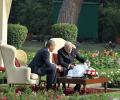
'One thing I've learned about nuclear power is that these are not fast kind of time-lines.'
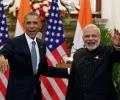
'At a time when the entire India-US relationship needs to be defined by President Trump and Prime Minister Modi, a fresh look at the liability issue has become urgent,' says Ambassador T P Sreenivasan, former Governor for India at the IAEA.
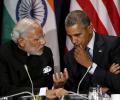
'Big countries do not agree on every set of issues.' 'Look, one of the differences in the relationship is that when we do not agree, we are sitting down and talking to each other.'
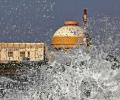
This would make India the world's second-biggest nuclear energy market after China

'Of all the areas that define the future for a strong US-India partnership, none is more important than our defence and security ties.'
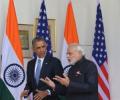
It is for the companies and the industry to ascertain where they want to run with the US-India civilian nuclear agreements reached by Washington and New Delhi, says United States Assistant Secretary of State Nisha Biswal. Aziz Haniffa reports for Rediff.com from Washington, DC
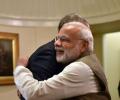
The camaraderie between Modi and Obama has taken the India-US relationship to unprecedented and transformative levels.

India and France on Monday inked an Inter-Governmental Agreement on the sale of 36 French fighter jets, Rafale, but were unable to sign the final deal due to some "financial" aspects, which are expected to be sorted out in "couple of days".
Seeking to boost the strategic ties, India and the US finalised the text of the Logistics Exchange Memorandum of Agreement.

PM Modi seems to be gradually ending India's strategic ambiguity

Govt is keen to push reforms in the insurance sector.

'There has definitely been a breakthrough in the nuclear logjam. It is good to see nuclear energy back on the rails,' says Dr Anil Kakodkar, former chairman, Atomic Energy Commission.

'Modi's investment in the relationship with Washington is the biggest deliverable of this visit. He means business and that's fantastic!'
 © 2026 Rediff.com - Advertise with us - Disclaimer - Privacy Policy - Sitemap - Feedback - About us - Terms of use - Grievances